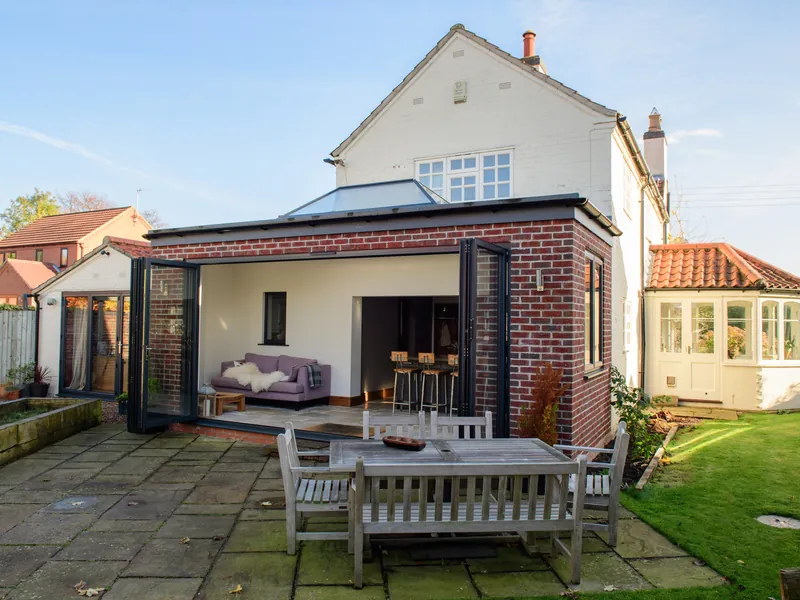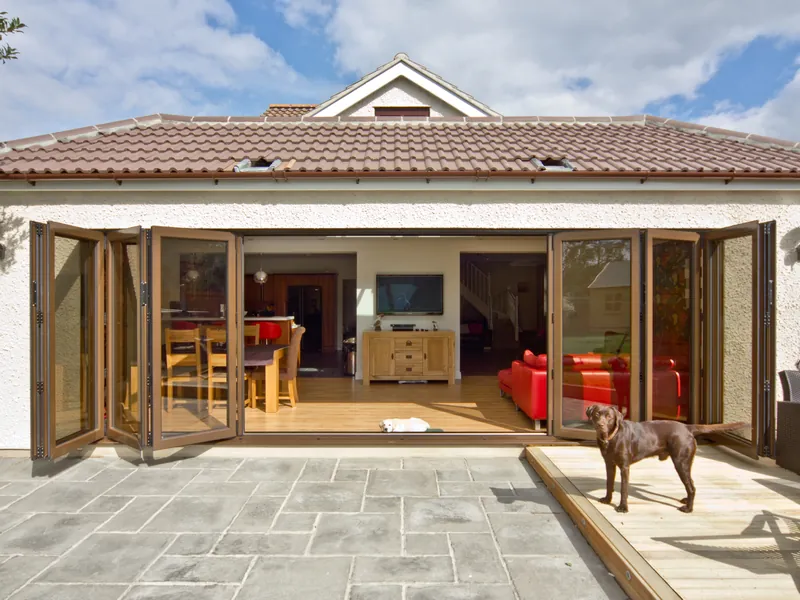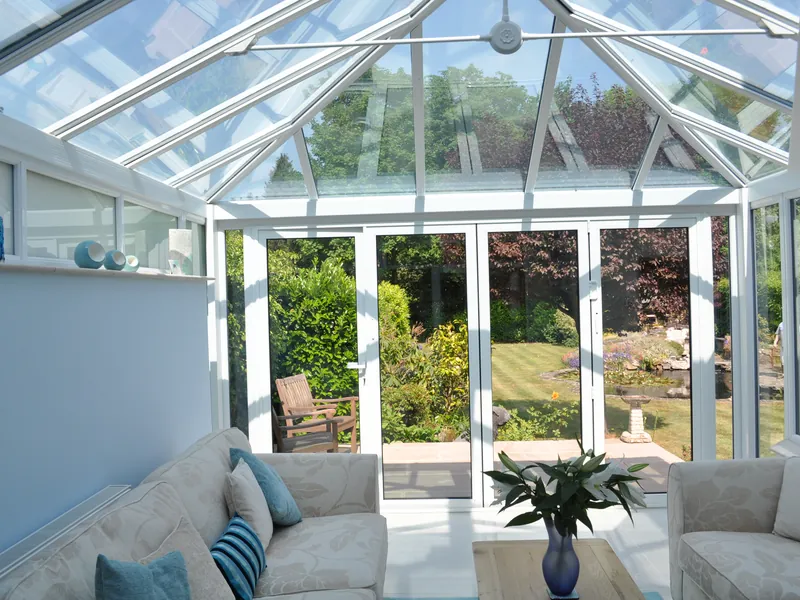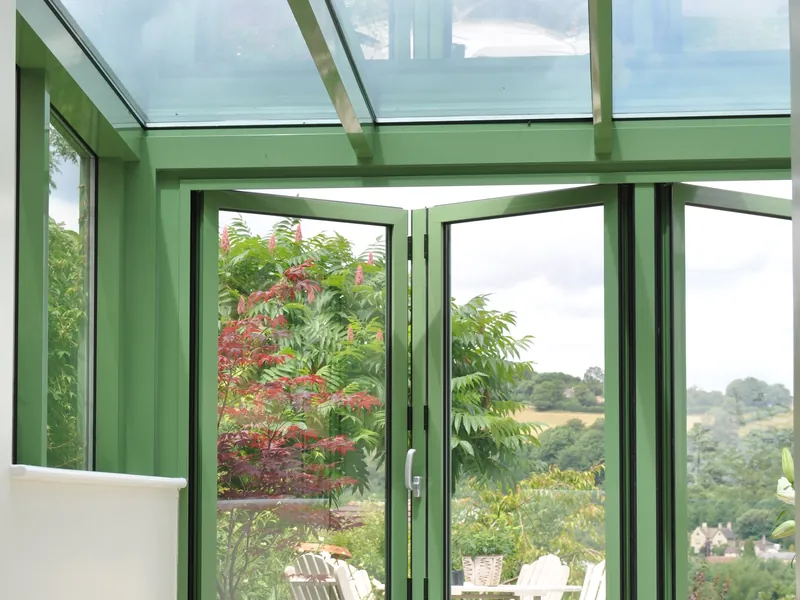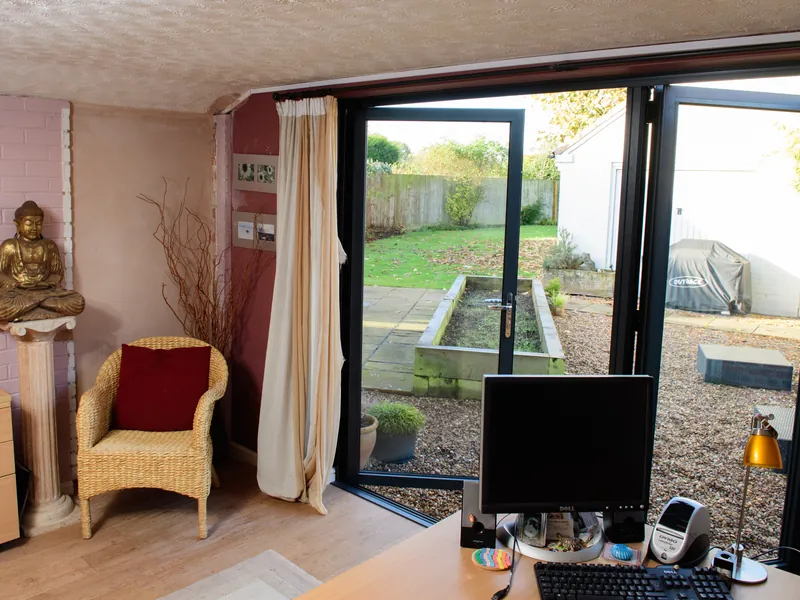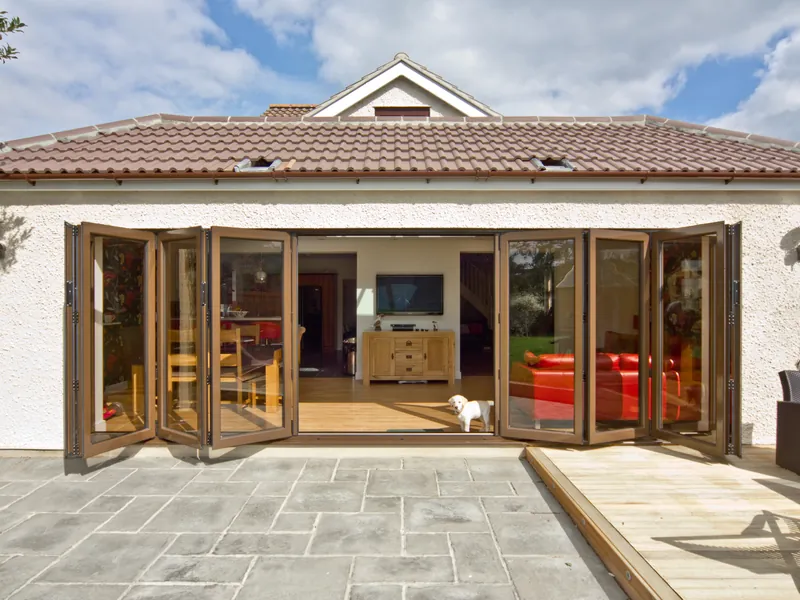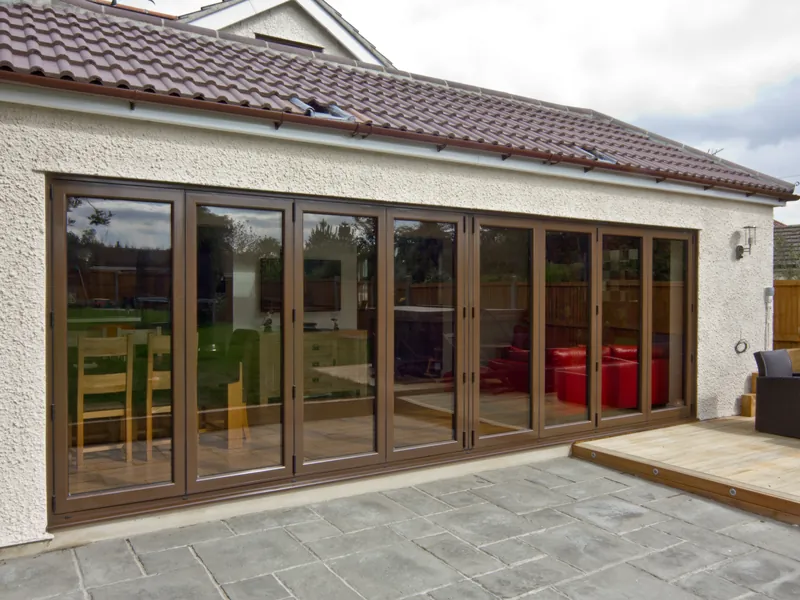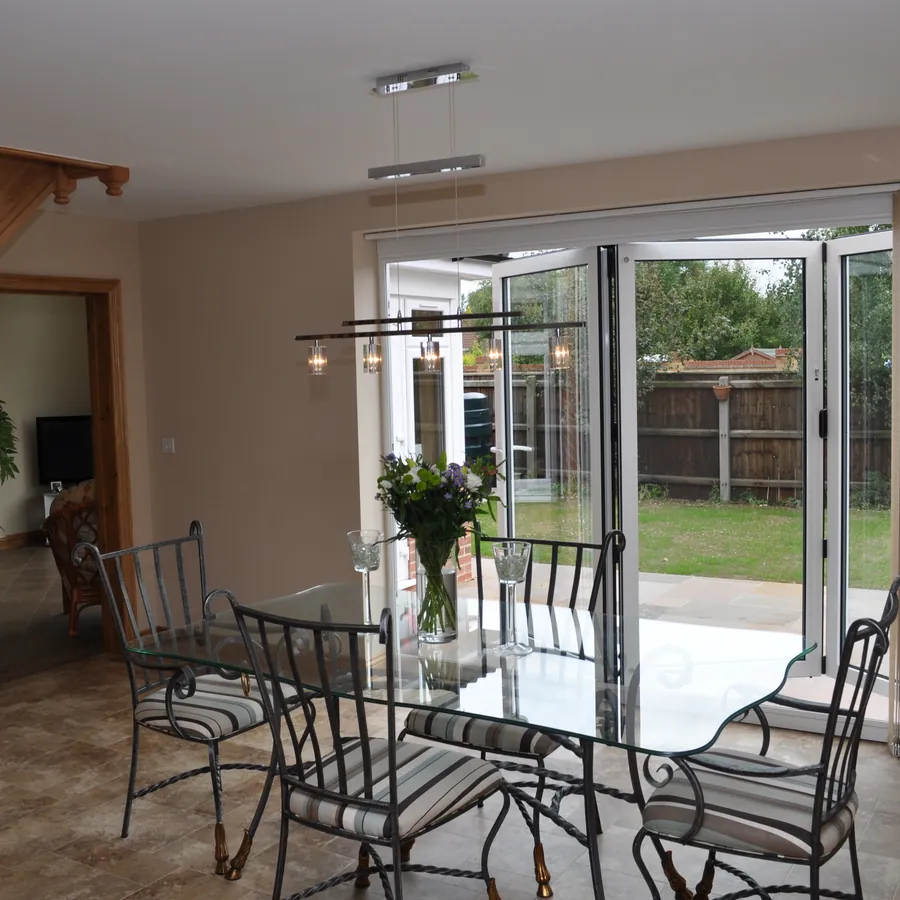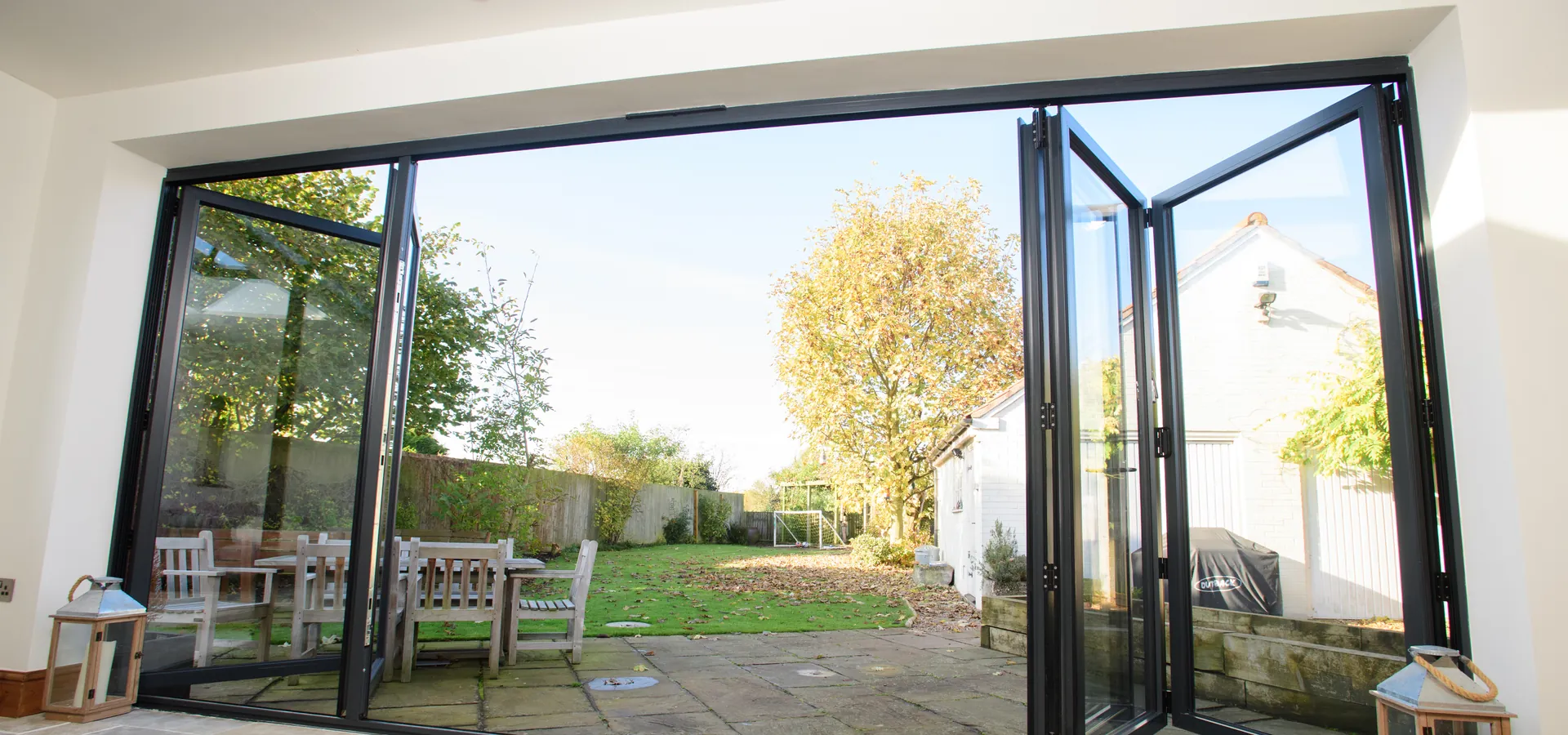
We design and fit made-to-measure bifold door sets in Abbey Wood, in aluminium and uPVC. This page is for homeowners who want to open a wide wall of the house to the garden. You will learn how bifolds work, which layout suits your space, what drives the cost and how to look after them.
Bifold doors are made of several glass panels joined by hinges. When you open them, the panels fold up like a concertina and stack neatly to one or both sides. On a warm day you can open the whole wall. In winter, closed bifolds act like a large, warm window. We are a local double glazing firm, and our installers are FENSA registered.
How Bifold Doors Work
Each panel hangs from a track at the top, or rolls on a track at the bottom. Most good systems are bottom rolling, as this puts the weight on the floor, not on the lintel above. The panels fold in pairs and stack at the side.
Most sets also have a traffic door. This is the first panel, which opens on its own like a normal door. You use it for day-to-day trips to the garden, without folding the whole set back.
Panels can fold to the inside or the outside. Folding out keeps the room clear. Folding in keeps the panels out of the rain and off the patio.
Aluminium or uPVC Bifolds
We fit bifolds in two main materials. Both are warm and secure, but they look and feel different.
Aluminium
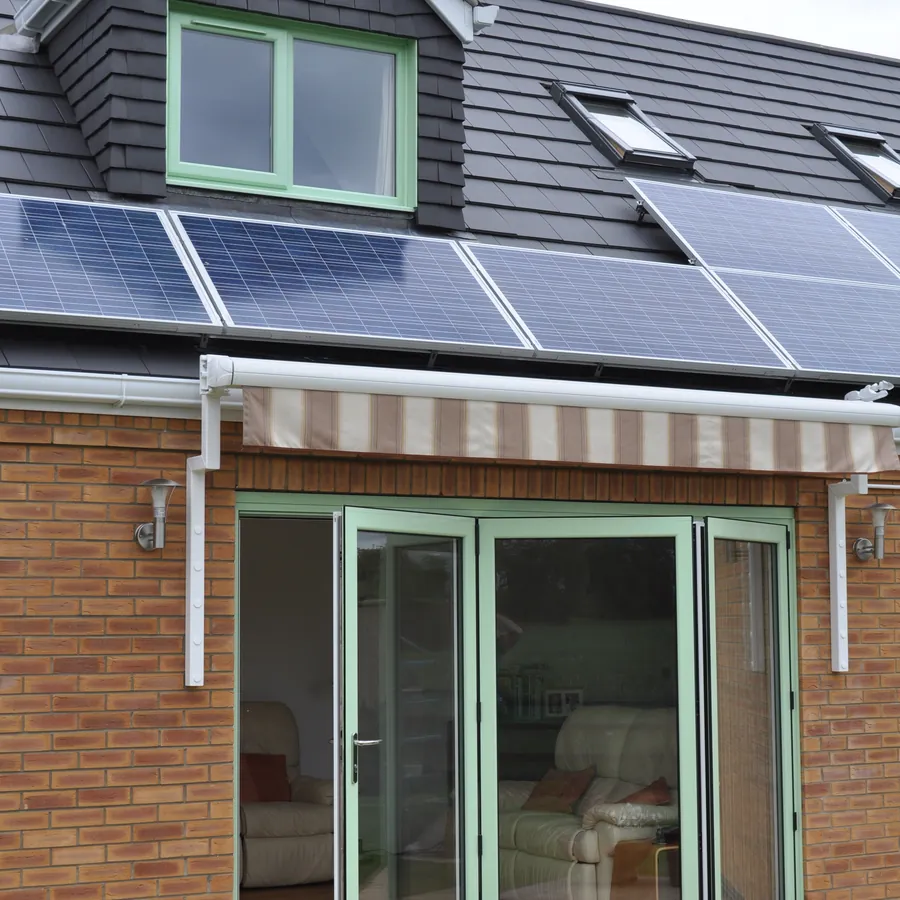
Aluminium is the most popular choice for bifolds. It is strong, so each panel can be wide and the frames can be slim. You see more glass and less frame. The powder-coated finish comes in a huge range of colours, and you can have one colour inside and another outside. A thermal break in the frame keeps the heat in.
uPVC
uPVC bifolds cost less and keep heat in well. The frames are thicker, so each panel tends to be narrower. They suit smaller openings, such as a kitchen or a conservatory. They come in white, grey, black and woodgrain finishes.
All our bifolds use double glazed units with a low-E coat and argon gas. Safety glass is standard, and it is beaded on the inside.
Choosing a Layout
The number of panels and the way they open make a big difference. Here are the most common layouts:
- Two panels. Good for small openings, where you might have fitted French doors.
- Three panels. A popular choice for a kitchen or a medium opening, with a traffic door at one end.
- Four or five panels. For wide openings in an extension or a garden room.
- Six or more panels. For very wide spans, often split to stack on both sides.
Narrow panels mean more frames, but each one is lighter to move. Wide panels give a clearer view, but take up more space when stacked. We help you balance the two on the survey.
Think too about the threshold. A low or flush threshold gives a near-level step to the patio. A standard threshold gives better weather protection on exposed sites.
Security and Weather Protection
A bifold is a large opening, so it needs strong locks. Our systems include:
- multi-point locks on the traffic door;
- shoot bolts that lock the folding panels at top and bottom;
- anti-snap cylinders;
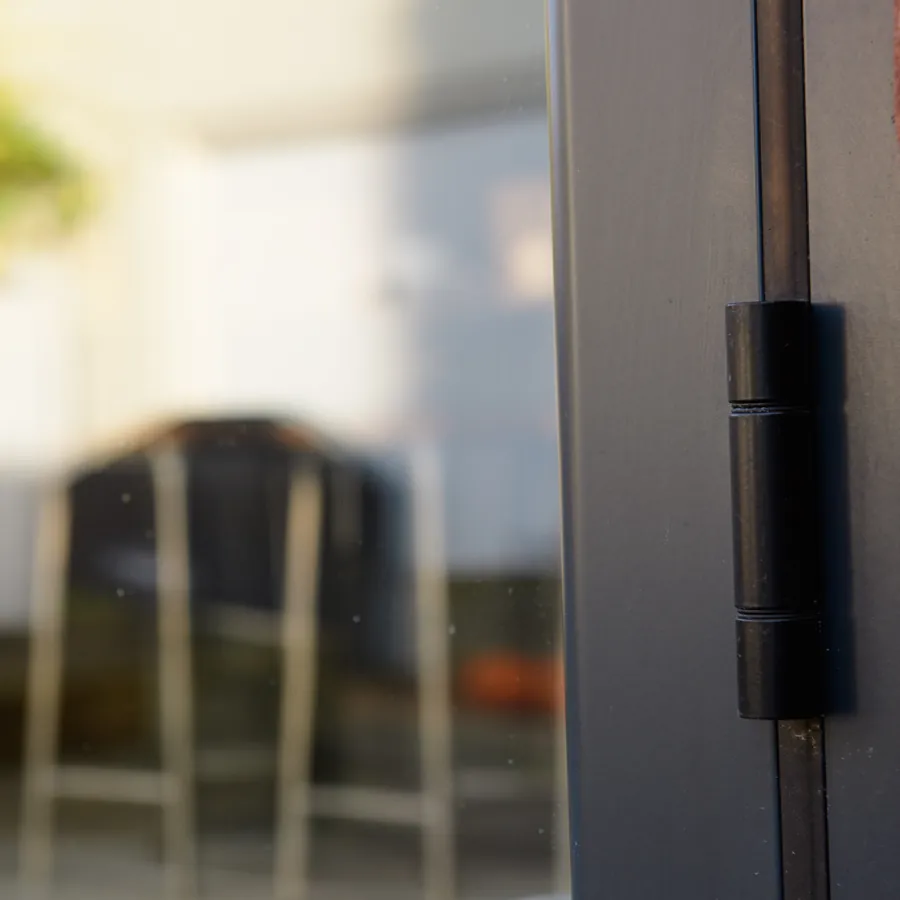
- hidden hinges that cannot be taken apart from outside;
- internal glazing beads so the glass cannot be removed.
Many of our bifold systems are tested to PAS 24, the UK door security standard. Good seals and brushes along every joint keep out wind and rain. Drain channels in the bottom track carry water away.
What Drives the Cost of Bifold Doors
We do not quote set prices online, because every bifold is made to measure. These are the main things that affect the price:
- Width. A wider opening needs more panels, more glass and more hardware.
- Material. Aluminium costs more than uPVC, but gives slimmer frames and wider panels.
- Number of panels. More panels mean more hinges, rollers and locks.
- Colour. Dual-colour and special finishes cost more than a single standard colour.
- Glass. Solar control, triple glazing or integral blinds add cost.
- Threshold. A flush, level threshold needs extra floor and drain work.
- Building work. Making a new opening, or widening an old one, needs a steel beam and making good.
After a free survey we give you a written, fixed quote that sets out the work and the payment stages. You can ask for a quote online at any time.
Fitting, Building Regulations and the Opening
Bifolds need a level, square opening to run smoothly. On the survey we check the floor, the walls and the lintel above. If you are taking out a wall or a window to fit bifolds, the opening will need a new beam. That part may need building control sign-off and, in some cases, a structural engineer.
The doors must meet Part L of the Building Regulations, which sets a U-value of 1.4 W/m²K or better for a replacement door. Because we are FENSA registered, we can self-certify the glazing. You can read about our accreditations to see what this covers.
Our full process is on how we work. In short, we survey, order your doors to size, fit them and adjust every panel before we leave. Most sets are fitted in a day once the opening is ready.
Caring for Bifold Doors
Bifolds need a little care to keep them running well. Most of it takes a few minutes:
- Vacuum the bottom track often to remove grit and leaves.
- Wipe the frames and glass with warm soapy water.
- Oil the locks and hinges once or twice a year.
- Keep the drain holes in the track clear.
- Check the panels still line up after the first few months, as new homes can settle.
Do not use harsh cleaners or scourers on the frames. Every set comes with our 10-year guarantee.
Bifolds Compared With Other Doors
Bifolds are not always the best fit. It helps to compare them with other options.
- French doors suit smaller openings and period homes. See our French doors page.
- Sliding doors have fewer, larger panes and slimmer frames. They do not open the full width, but give a clearer view when shut.
- Composite doors are a solid, secure choice for a single back or front door. See our composite doors page.
You can compare every style on our main double glazing doors page. To match your bifolds to new windows, see our double glazing windows.
Frequently Asked Questions
How do bifold doors link indoor and outdoor space?
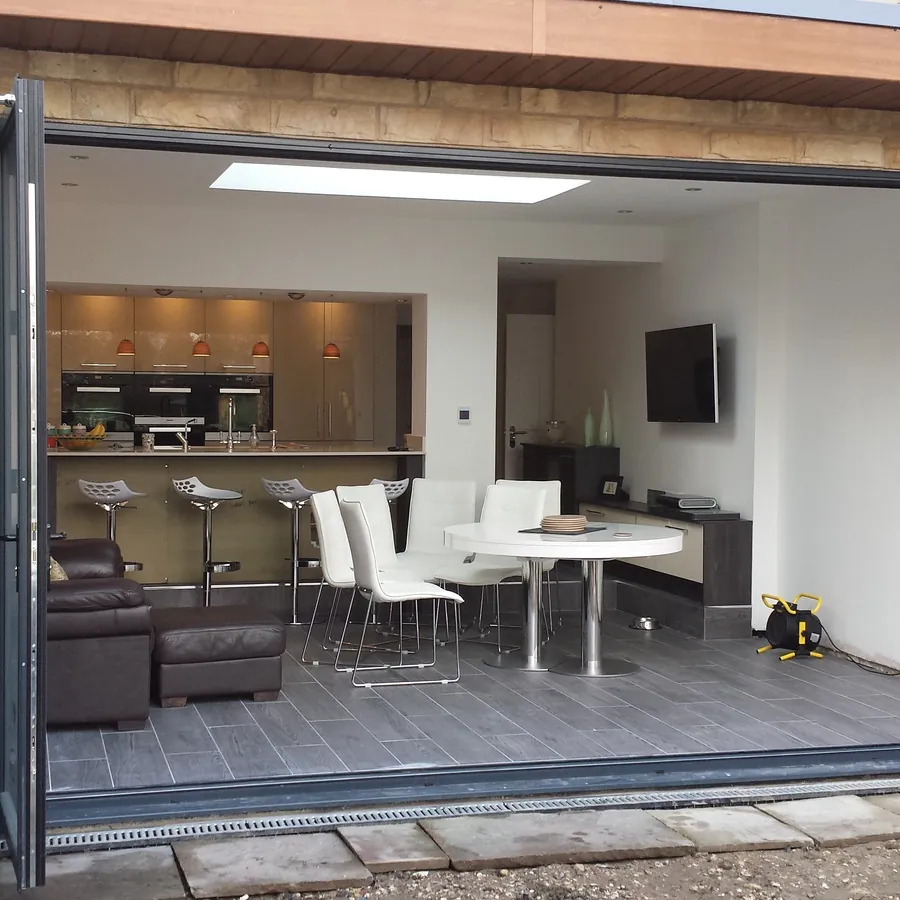
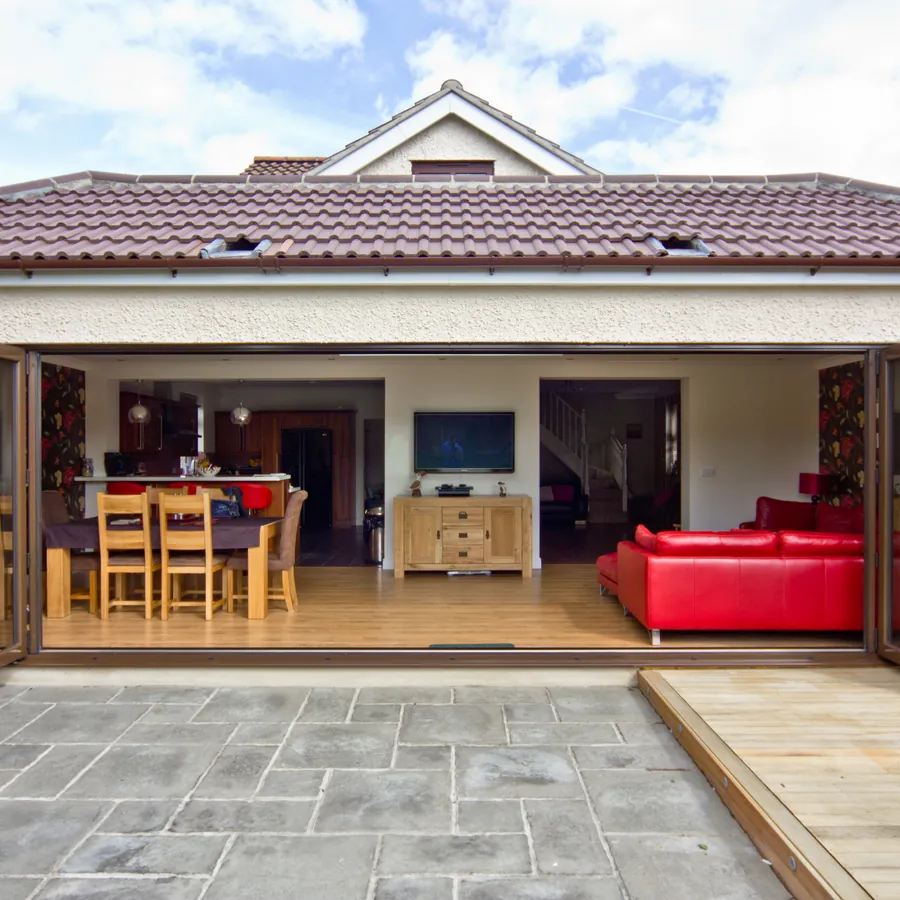
When open, bifold doors fold back and stack at the side, so the whole wall opens up. The room and the patio feel like one space. A low threshold makes the step between them almost level. In winter, the closed doors act like a large window and let in lots of light. This makes bifolds a popular choice for kitchens and garden rooms.
Are bifold doors suitable for all homes?
Most homes can have bifold doors, but the opening matters. You need a wall with enough width and a sound lintel or beam above. The floor must be level so the panels run smoothly. You also need space inside or outside for the panels to stack. On a small opening, French doors may suit you better. We check all of this on the survey.
What maintenance do bifold doors need?
Keep the bottom track clean, as grit is the main cause of stiff panels. Vacuum it often and wipe it down. Clean the frames and glass with warm soapy water. Oil the locks and hinges once or twice a year. Keep the drain holes clear. If the panels start to drop or rub, call us and we will adjust them.
Can bifold doors be fitted in winter?
Yes. We fit bifolds all year round. Most sets go in within a day once the opening is ready, so your home is open to the weather for only a short time. We protect your floors and keep the room as warm as we can. In very wet or windy weather we may move the date to make sure the seals are fitted well.
Are bifold doors secure?
Yes. Our bifolds have multi-point locks on the traffic door and shoot bolts on the folding panels. The hinges are hidden or protected, and the glass is beaded on the inside. Many of our systems are tested to PAS 24, the UK door security standard. Laminated glass is also an option if you want extra protection on the ground floor.